



Portable evaporative coolers have rapidly become one of the most practical cooling solutions for outdoor work sites, patios, sporting events, and open-air commercial operations across the USA — and for good reason. They deliver powerful airflow and genuine temperature reduction at a fraction of the energy cost of traditional air conditioning, with no refrigerants, no exhaust hoses, and no complex installation.
But like any purpose-built technology, a portable evaporative cooler outdoor application is different from an indoor one — and getting the most out of your unit outdoors requires understanding the conditions that help it perform at its best, the mistakes that undercut its effectiveness, and the maintenance habits that protect your investment season after season.
Whether you are a first-time evaporative cooler buyer or an experienced user looking to optimize your outdoor setup, this guide covers the essential dos and don'ts for outdoor evaporative cooler use in 2026.
To explore Blueco's industrial-grade outdoor-ready portable evaporative cooler lineup, start at the Blueco homepage.
How Evaporative Cooling Works — and Why It Matters Outdoors
Before getting into dos and don'ts, a brief understanding of the underlying technology makes the guidance easier to apply.
An evaporative cooler — also called a swamp cooler — cools air through a simple, energy-efficient physical process: a high-velocity fan draws warm ambient air through water-saturated pads. As the water evaporates from the pad surface, it absorbs significant heat energy from the passing air, and the resulting airflow delivered into the space is meaningfully cooler than the air that entered.
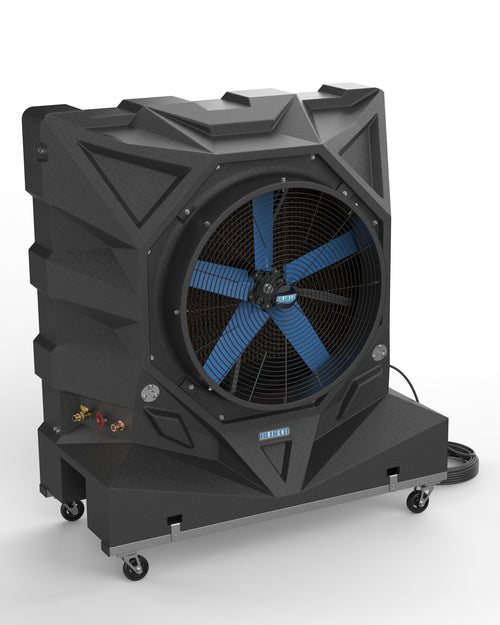
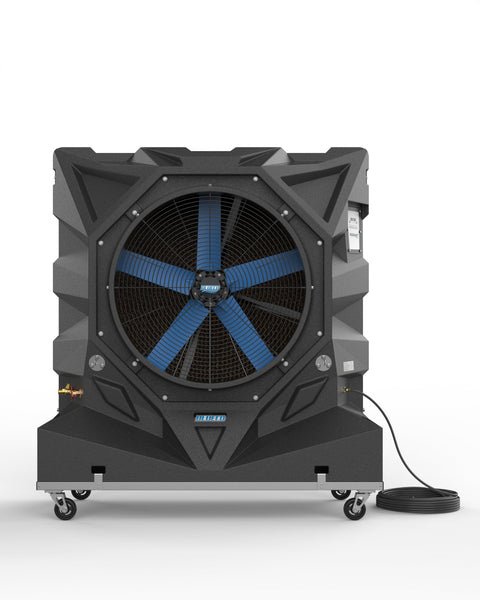
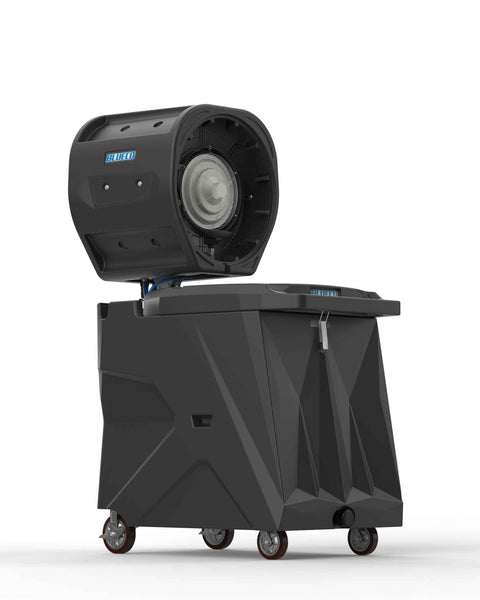
The cooling effect is real and substantial. Blueco's VARIANT-36 Portable Evaporative Cooler, for example, delivers 18,800 CFM of airflow across a 5,100 square foot coverage area — all while drawing only 0.75kW of power, roughly equivalent to a standard ceiling fan. That energy efficiency — up to 75% less electricity than refrigerated air conditioning — is one of the most compelling reasons evaporative coolers have become the preferred solution at outdoor events, construction sites, industrial facilities, and large open-air commercial spaces.
Critically, however, the evaporation process requires dry air to work efficiently. In high-humidity environments, where the air is already moisture-saturated, the evaporation rate slows and so does the cooling effect. This is the single most important variable to understand before deploying an evaporative cooler outdoors.
The Dos: Getting Maximum Performance from Your Outdoor Evaporative Cooler
DO: Choose a Low-to-Moderate Humidity Environment
Best evaporative coolers perform most effectively when the ambient relative humidity is below 60%. In the hot, dry climates of the American Southwest — Arizona, Nevada, New Mexico, inland California, and Colorado — outdoor evaporative coolers regularly achieve temperature reductions of 15°F to 30°F even in open-air conditions. In the more humid Southeast, Gulf Coast, and Mid-Atlantic regions, results are more modest, and supplemental airflow from fans may be needed.
Blueco's VARIANT-36 addresses this with a water valve adjustment feature that allows users to dial down water flow when ambient humidity is elevated — reducing the amount of additional moisture added to the air to maintain cooling effectiveness in variable conditions.
DO: Position for Airflow Direction — Not Just Coverage
Where you place an evaporative cooler outdoor matters enormously. Point the unit so it delivers cooled air across the occupied zone — not into a wall, structure, or obstruction.
For open outdoor setups like patios, bleacher areas, or outdoor work zones, position the unit upwind so the cooled air flows toward people rather than away. In partially covered outdoor spaces like tent structures or pergolas, angle the unit so airflow moves through the space and exits on the opposite side — this prevents humid air from accumulating and maintains the cross-ventilation that sustains cooling effectiveness.
DO: Use the Water Valve Adjustment for Climate-Specific Tuning
One of the most underused features on a premium portable evaporative cooler is the water valve control. In extremely hot and dry conditions, fully opening the water valve maximizes water flow through the cooling pads, producing the most aggressive cooling effect available.
In warmer but slightly more humid conditions, dialing down the valve reduces moisture output while still maintaining meaningful airflow and cooling — allowing the unit to operate usefully in a broader range of outdoor conditions than a fixed-flow evaporative cooler can manage. This customization is a key differentiator between an industrial-grade unit like the Blueco VARIANT-36 and consumer-grade alternatives.
DO: Keep the Water Reservoir or Float System Well Maintained
For outdoor operation — especially in high-temperature conditions where evaporation rates are highest — water consumption accelerates significantly. If your unit operates with a manual water reservoir, check levels frequently during use.
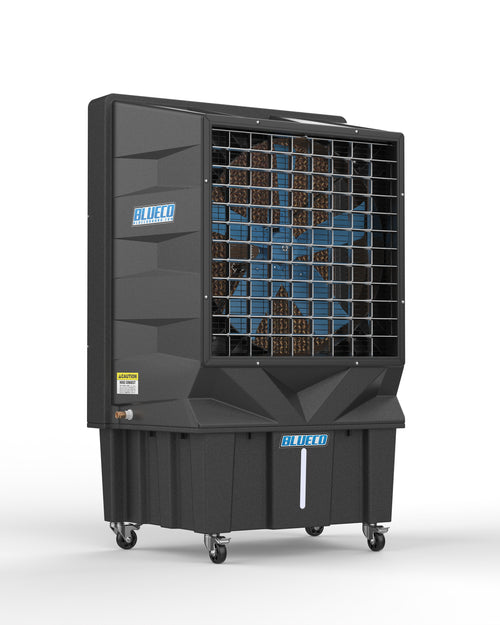
Blueco's LEGACY-30 addresses this directly with an automatic float system connected to a standard garden hose, which maintains constant water levels without manual monitoring throughout the work day. For extended outdoor events or construction site use, this kind of automated water management eliminates the risk of the unit running dry and losing performance mid-operation.
DO: Use the Variable Speed Control to Match Conditions
Outdoor conditions change throughout the day — temperatures peak in the early afternoon, winds shift, and the effective cooling demand varies. A variable speed control that adjusts from 1 to 100 (rather than the conventional low/medium/high settings) allows you to dial in the exact airflow needed for current conditions rather than accepting a fixed output. This improves both energy efficiency and cooling comfort simultaneously.
DO: Maintain Cooling Pads Regularly
The multi-piece cooling pad media in a portable evaporative cooler is the primary surface where heat exchange occurs. Over time, mineral deposits from water, dust, and organic matter reduce pad efficiency. For outdoor use — where dust, pollen, and airborne debris are more prevalent than indoors — inspect and clean pads at least once every two to three weeks during peak-use periods. Replacing pads at the start of each season ensures maximum cooling efficiency from the first day of use.
The Don'ts: Mistakes That Undercut Your Outdoor Evaporative Cooler
DON'T: Operate in Enclosed or Poorly Ventilated Spaces
Evaporative coolers add moisture to the air they cool. In a sealed or poorly ventilated space, that moisture accumulates and the humidity builds until the cooling process becomes ineffective — and the space becomes uncomfortable.
Outdoors, this is rarely an issue. But in semi-enclosed tent structures, temporary event canopies, or partially walled outdoor areas, ensure there is adequate air egress so humid output air can escape the space as fast as fresh dry air enters. The rule is simple: the more open the space, the better the evaporative cooler performs.
DON'T: Position the Unit Against the Prevailing Wind
Positioning an evaporative cooler so that natural wind blows directly into the back of the unit reduces its effective CFM output and can disrupt the air flow through the cooling pads, lowering cooling efficiency. Orient the unit so the fan exhaust faces into the occupied zone and the intake side faces a direction that is cross-wind or angled, rather than directly into the headwind.
DON'T: Ignore Humidity Readings
If you are setting up for an outdoor event and the local weather forecast shows relative humidity above 65–70%, evaporative coolers alone may not deliver the level of cooling comfort your audience or workforce expects. In high-humidity conditions, supplementing with high-volume fans to improve air movement or adjusting the water valve to reduce additional moisture output gives you the best available result.
Blueco's blog resource on temperature reduction provides detailed guidance on how relative humidity and ambient temperature interact with evaporative cooling output — a useful reference for planning any outdoor deployment.
DON'T: Skip the Pre-Operation Pad Soak
Starting an evaporative cooler immediately on first use without allowing the pads to fully saturate first reduces initial cooling effectiveness. Allow two to three minutes of water circulation before activating the fan at full speed. This simple step ensures the pads are evenly saturated before airflow passes through them, maximizing the heat exchange from the first minute of operation.
DON'T: Leave Water Sitting in the Unit Between Uses
If your unit will be inactive for several days or longer, drain the water reservoir before storing it. Standing water in an evaporative cooler reservoir promotes algae growth, mineral scale buildup on the pads, and unpleasant odors. Draining, wiping down the interior, and allowing the unit to dry before storage is the most effective way to protect the cooler's long-term performance and hygiene.
Why the Blueco VARIANT-36 Is Built for Serious Outdoor Use
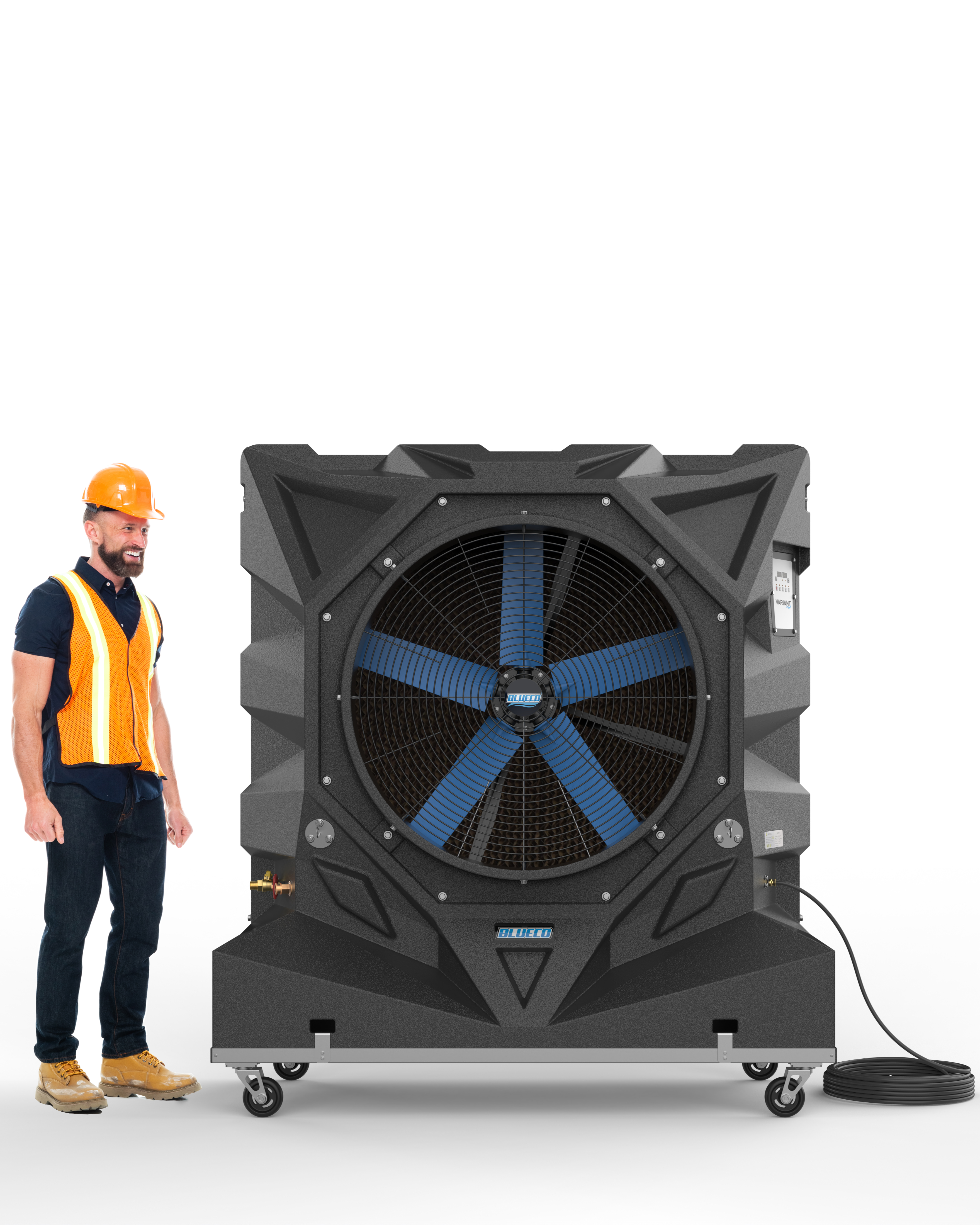
The Blueco VARIANT-36 Portable Evaporative Cooler is engineered specifically for the demands of outdoor industrial and commercial applications. With 18,800 CFM airflow, 5,100 sq ft cooling coverage, and a direct-drive EC motor drawing only 0.75kW, it delivers industrial cooling output at ceiling-fan energy costs.
The variable water valve adjustment, the 60" x 60" x 6" thick multi-piece cooling pad media, and the locking caster wheels for easy repositioning across job sites make the VARIANT-36 one of the most operationally complete portable evaporative coolers available to US buyers in 2026.
For full product specifications, pricing, and ordering, visit the VARIANT-36 product page directly
Blueco Brand
- Address: 2615 N Arygle , Fresno CA
- Phone: 1-866-865-1902
- Email: Support@bluecobrand.com
FAQs About Portable Evaporative Coolers for Outdoor Use
Q1. How much can a portable evaporative cooler reduce temperature outdoors?
In dry climates with relative humidity below 60%, a quality portable evaporative cooler outdoor unit can reduce perceived air temperature by 15°F to 30°F in the direct airflow zone. The Blueco LEGACY-30 is rated for up to 30°F temperature reduction in optimal conditions, and the VARIANT-36 covers up to 5,100 square feet of outdoor space. Actual results vary with ambient temperature, humidity, and wind conditions.
Q2. What humidity level is too high for an evaporative cooler?
Most manufacturers and cooling engineers recommend evaporative coolers for environments with relative humidity below 60%. Above 60–70% humidity, the evaporation rate slows significantly because the air is already carrying substantial moisture, reducing the cooling effect. In high-humidity outdoor settings, reducing the water valve setting and maximizing airflow can still provide meaningful air movement and moderate cooling even when the maximum temperature drop is not achievable.
Q3. How energy efficient are portable evaporative coolers compared to air conditioners?
The difference is dramatic. The Blueco VARIANT-36 delivers 18,800 CFM of cooled air while drawing only 0.75kW — comparable to a household ceiling fan. Traditional refrigerated air conditioning covering the same area would draw 10kW to 15kW or more. Evaporative coolers use up to 75% less electricity than equivalent air conditioning systems.
Q4. Do portable evaporative coolers work in direct sunlight outdoors?
Yes, but performance is affected by solar heat load. If the unit itself is in direct sunlight, the intake air temperature is higher, which reduces the net cooling effect delivered. Where possible, shade the cooler itself while directing its output toward the occupied space. Shading the cooler's intake side is a simple field modification that meaningfully improves cooling output in direct sun conditions.
Q5. How often should I clean or replace the cooling pads?
For regular outdoor use, inspect cooling pads every two to three weeks and clean mineral scale with a diluted white vinegar solution or manufacturer-recommended descaling agent. Replace pads at the start of each cooling season or at any point when visible degradation, persistent odor after cleaning, or reduced cooling output is observed. Pad quality is directly linked to cooling efficiency — worn pads are the most common reason for reduced performance in a well-maintained unit.
Q6. Where can I buy the best portable evaporative cooler for outdoor use in the USA?
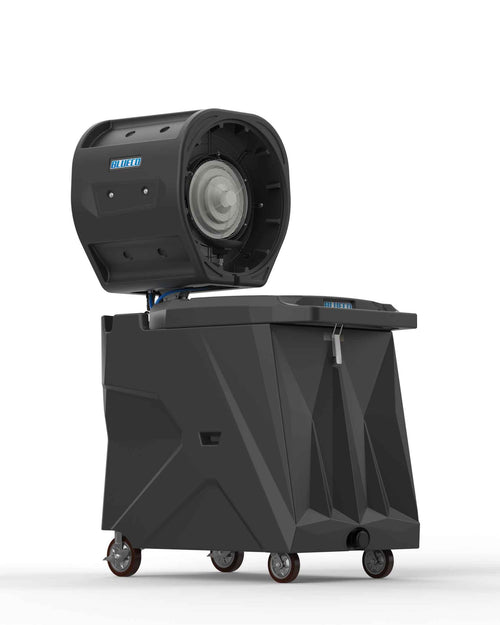
Blueco offers a range of industrial-grade portable evaporative coolers — including the VARIANT-36, LEGACY-30, and AIRSTREAM-12 — built for outdoor commercial, industrial, and event applications. You can browse the full lineup above.
Conclusion
A portable evaporative cooler is one of the most energy-efficient and operationally flexible cooling tools available for outdoor use — but its effectiveness is directly tied to how well it is deployed. Matching the unit to the right humidity conditions, positioning it for optimal airflow, maintaining the water system and pads consistently, and using the variable controls available on premium units like the Blueco VARIANT-36 are all decisions that compound into real differences in cooling comfort and operating cost.
For operations in dry-climate USA regions — where evaporative coolers can cut cooling energy costs by up to 75% compared to refrigerated air conditioning — investing in an industrial-grade unit built for serious outdoor performance is one of the highest-return equipment decisions available.
Share:
Top Heavy Duty Electric Pallet Jacks for High-Volume Warehouses
Improving Worker Comfort: HVLS Fans That Reduce Heat Stress in Warehouses
1 comment
Good Instructions https://subchathakur.wixsite.com/igurucool