



Heat stress in warehouses is not a seasonal inconvenience — it is a documented safety hazard with measurable consequences for workforce health, productivity, and legal compliance. OSHA reports that dozens of worker fatalities occur annually in the USA due to heat exposure, with thousands more workers falling ill from heat-related conditions during the course of a work year. For warehouse operators and facility managers, managing heat is not optional. It is a responsibility.
HVLS fans — High-Volume, Low-Speed ceiling fans — have emerged as the most operationally and economically practical solution to warehouse heat stress in large industrial facilities. Unlike traditional high-speed floor or wall fans that move air in narrow, turbulent columns, HVLS fans for warehouse environments move enormous volumes of air gently and uniformly across the entire facility floor. The result is a measurable reduction in effective temperature, improved air quality, a more comfortable and productive workforce, and a meaningful reduction in HVAC energy consumption.
This guide explains the science behind why HVLS fans work so effectively for heat stress reduction, what to look for in the best HVLS fans for warehouse applications, and why the Blueco Eurus Series represents a benchmark for industrial HVLS performance in 2026.
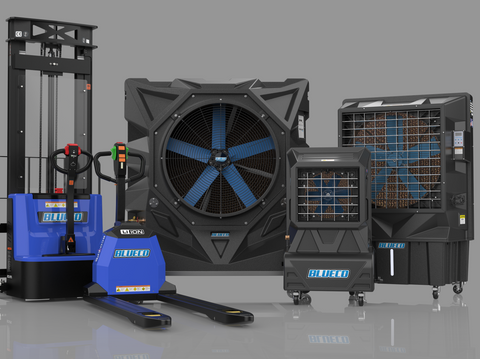
For the full Blueco industrial equipment lineup including HVLS fans and evaporative coolers, start at the Blueco homepage.
The Real Cost of Heat Stress in a Warehouse Environment
The impact of elevated warehouse temperatures on workforce performance has been studied extensively — and the numbers are significant.
A study conducted by NASA found that when in-plant temperatures rise to 85°F, worker output drops by 18 percent and errors increase by 40 percent. In extreme conditions at 104°F with high humidity, worker productivity can collapse to as low as 25% of normal capacity — effectively 15 minutes of productive work per hour. Across the US economy, heat stress in industrial environments is estimated to cost approximately $100 billion annually in lost productivity, medical expenses, and related costs.
Beyond productivity, there is a clear legal dimension. OSHA's heat safety standards require employers to provide working conditions that protect employees from known heat hazards — and in warehouses where ambient temperatures regularly exceed 80°F to 85°F during summer months, failing to implement effective heat mitigation measures creates significant liability exposure.
The direct solution for most warehouse facilities is not full air conditioning — which is often cost-prohibitive in large open structures with high ceilings, frequent dock door openings, and massive air volume — but rather a strategic air movement strategy centered on HVLS fans for warehouse deployment.
How HVLS Fans Work — and Why They Outperform Alternatives
HVLS fans operate on a fundamentally different principle from conventional high-speed fans. Their large diameter blades — typically 8 to 24 feet — rotate at low RPM to generate a wide, gentle column of air that moves downward from the ceiling and spreads horizontally across the floor in all directions.
This air column creates a light, steady breeze across the entire coverage zone at floor level. When that breeze reaches workers, it creates an evaporative cooling effect on the skin — lowering the perceived temperature by 10 to 12°F even when the ambient air temperature remains unchanged. A warehouse environment at 84°F with an HVLS fan moving air at 3 mph is experienced by workers as approximately 73°F — a difference that transforms a heat-stress environment into a comfortable working condition with no additional cooling infrastructure.
A single HVLS fan can cover up to 20,000 square feet of warehouse floor space — replacing 10 to 20 conventional floor fans while eliminating the floor-level obstructions, trip hazards, and noise those fans create. That 10-to-1 or 20-to-1 replacement ratio makes the economics of HVLS installation straightforward in nearly any large-format facility.
In winter, HVLS fans can be reversed to push warm stratified air down from high ceilings — where heat typically collects in industrial buildings — back to floor level where workers operate. This destratification function can reduce heating costs by making existing HVAC systems operate more efficiently, with studies showing HVLS-equipped facilities achieving energy consumption reductions of up to 30%.
What to Look for in the Best HVLS Fans for Warehouse Applications
Not all HVLS fans deliver equivalent performance. When evaluating options for a warehouse deployment, the following specifications are the most operationally relevant:
Motor Technology: PMSM vs. AC Induction
The motor type determines energy efficiency, noise level, maintenance requirements, and operational longevity. Permanent Magnet Synchronous Motors (PMSM) — also called direct-drive permanent magnet motors — are the current standard in premium HVLS fans because they eliminate gearboxes and oil lubrication requirements entirely. No gearbox means no oil to change, no gear wear to monitor, and no mechanical failure point that can take a production floor offline mid-shift.
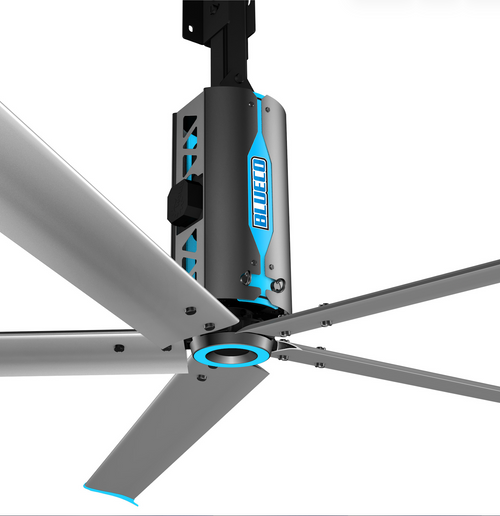
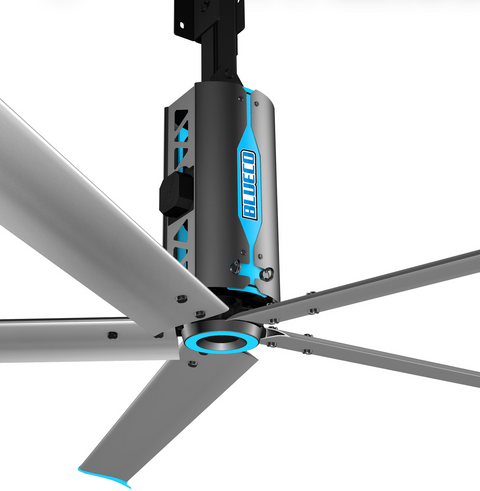
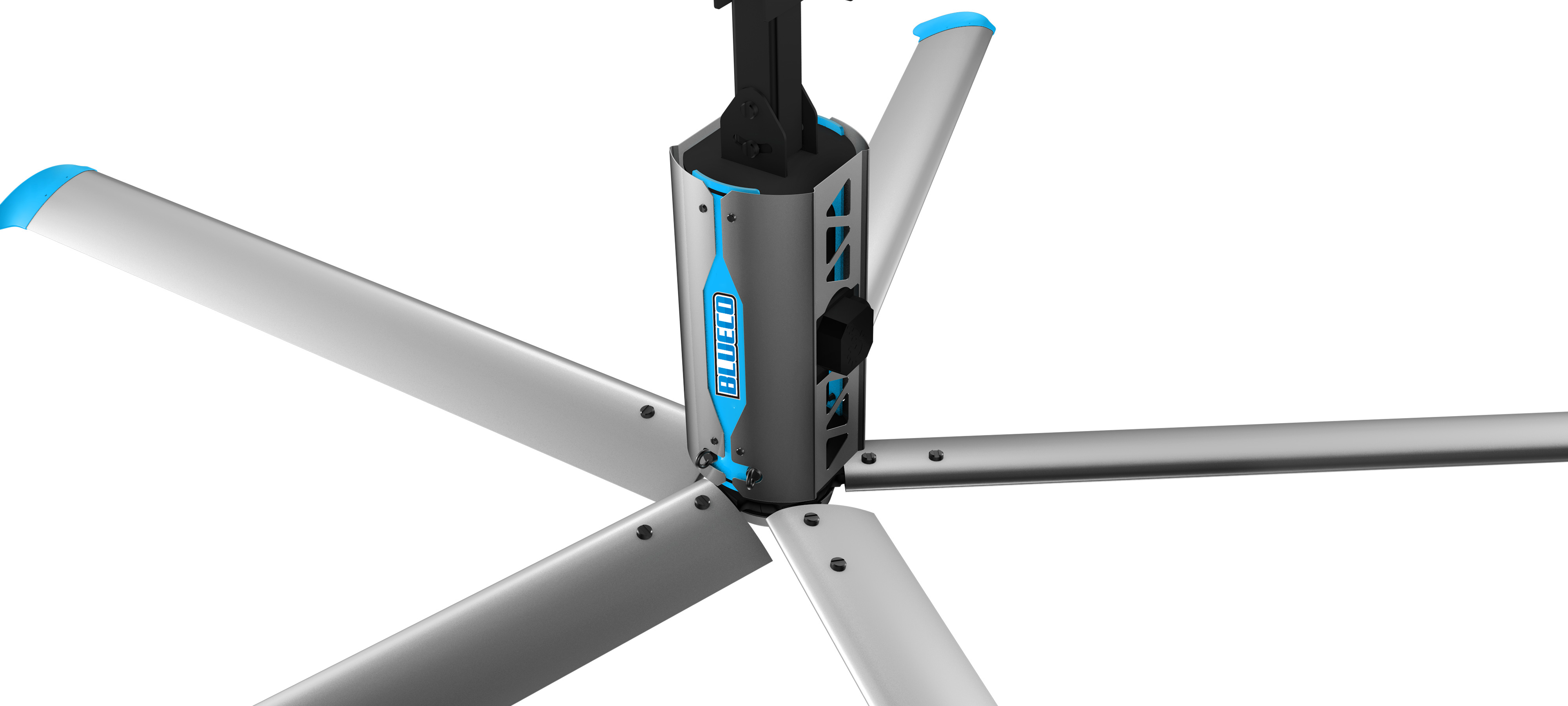
Blueco's Eurus Series uses a PMSM direct-drive motor that eliminates both gear and oil lubrication permanently. This dramatically reduces maintenance costs and operational downtime compared to earlier-generation HVLS fans that required regular gearbox servicing.
Fan Diameter and Coverage Area
Fan diameter directly determines how much floor area a single unit can cover effectively. The Blueco Eurus Series 13ft model covers 5,000 square feet per fan at operational ceiling heights from 14 to 45 feet. For warehouses above 15,000 square feet, multiple units are deployed in a grid pattern that ensures uniform airflow across the entire facility floor without dead zones.
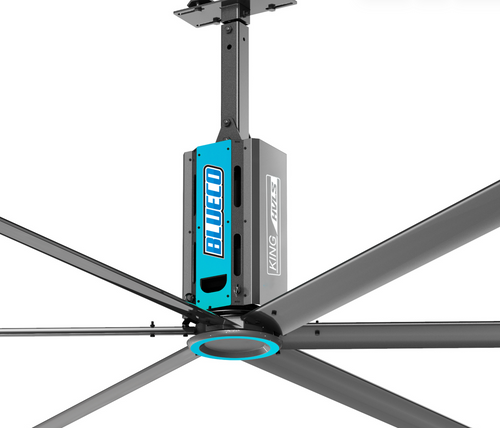
Larger facilities benefit from Blueco's King Series 18ft HVLS fan, which scales coverage and airflow output further for higher-ceiling, higher-volume distribution center environments.
Power Draw and Energy Efficiency
Energy efficiency is the single biggest economic argument for HVLS fans in commercial facilities. The Blueco Eurus Series 13ft operates at just 0.56kW (approximately 0.75 HP) while covering 5,000 square feet. Compared to the 10 to 20 conventional floor fans it replaces — each drawing 0.1 to 0.3kW — the HVLS unit delivers the same or superior coverage at a fraction of the cumulative power draw, while also eliminating the safety hazards and maintenance overhead of multiple ground-level fans.
Speed Range and Variable Control
Operational flexibility matters in real warehouse environments where temperature and occupancy levels vary across shifts and seasons. The Blueco Eurus Series operates across a 40 to 102 RPM range on variable speed control, allowing facility managers to dial in the exact airflow level needed for current conditions rather than cycling between a fixed low, medium, or high setting.
Installation Requirements
HVLS ceiling fans are ceiling-mounted, which means installation involves structural assessment of the ceiling mounting point and electrical connection. The Blueco Eurus Series operates on 220V single-phase power — a standard commercial/industrial supply that does not require dedicated three-phase power infrastructure in most facilities. This reduces installation complexity and cost in the majority of warehouse environments.
The Blueco Eurus Series: Industrial HVLS Performance Built for Warehouses
The Blueco Eurus Series 13ft HVLS Fan is Blueco's industrial-grade ceiling fan designed specifically for high-ceiling warehouse, manufacturing, and distribution center applications.
Key specifications at a glance:
The PMSM direct-drive motor eliminates the two most common failure points in industrial HVLS fans — gearbox wear and lubrication maintenance — reducing total cost of ownership and maximizing uptime. The variable speed control gives facility managers precise operational flexibility across seasonal and shift-by-shift conditions. And at 0.56kW, the Eurus Series delivers industrial-scale air movement at ceiling-fan-level energy costs — a combination that produces a return on investment measurable within a single cooling season for most warehouses.
For complete product specifications, pricing, and ordering, visit the Eurus Series product page.
Building a Comprehensive Heat Stress Management Strategy
HVLS fans are the operational backbone of a warehouse heat stress management strategy, but they deliver maximum results when integrated with complementary measures:
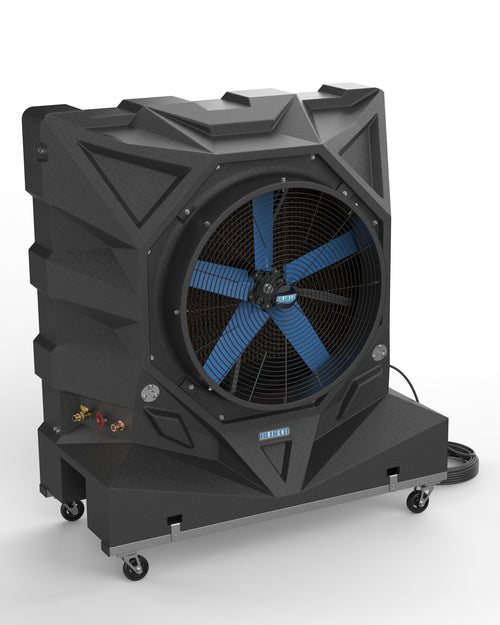
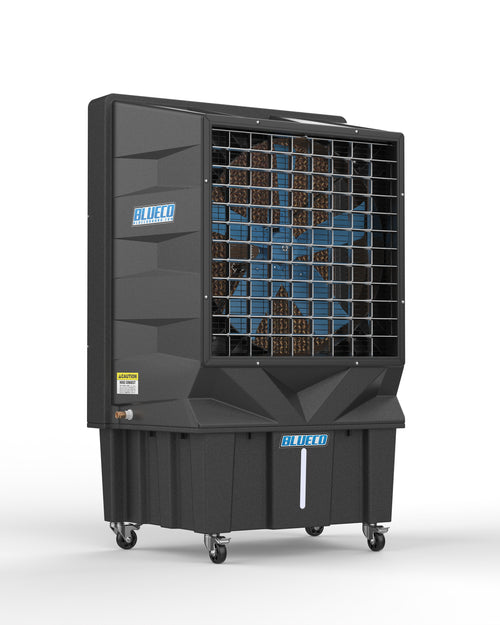
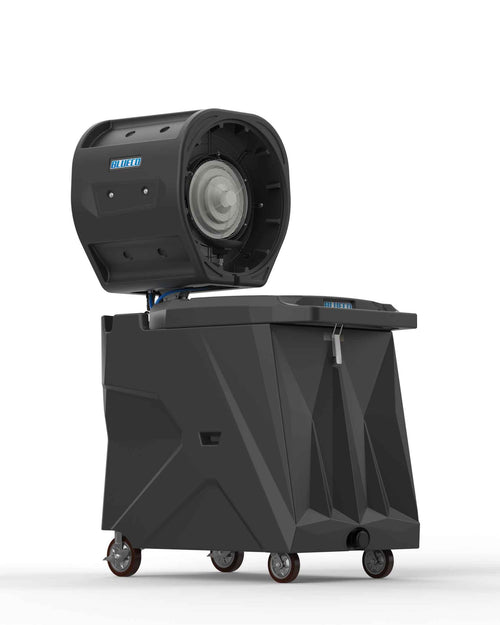
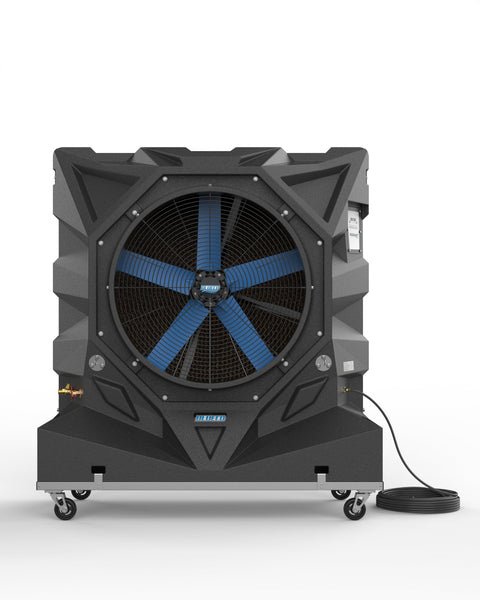
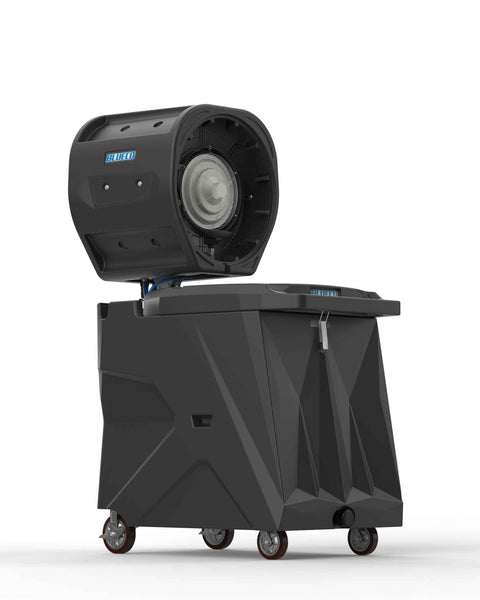
- Portable evaporative coolers positioned at dock doors, high-traffic work stations, and enclosed workspaces that ceiling fans cannot reach directly supplement HVLS coverage with targeted spot cooling.
- Dock door management — keeping doors closed when not in use reduces the ingress of hot outdoor air during peak summer temperatures.
- HVAC thermostat adjustment — because the wind chill effect of HVLS fans allows workers to feel comfortable at ambient temperatures 10 to 12°F higher than without air movement, facilities with existing air conditioning can raise thermostat setpoints by up to 5°F with no loss of worker comfort, reducing HVAC run time and energy costs simultaneously.
- Shift scheduling adjustments for physically demanding tasks away from peak-temperature hours (typically 12 PM to 4 PM) further reduces heat stress exposure for the workforce.
A well-designed air movement strategy built around the best HVLS fans for warehouse environments — such as the Blueco Eurus Series — and supplemented with targeted portable cooling tools represents the most cost-effective approach to heat stress compliance and worker comfort available to US facility operators in 2026.
Blueco Brand
- Address: 2615 N Arygle , Fresno CA
- Phone: 1-866-865-1902
- Email: Support@bluecobrand.com
FAQs About HVLS Fans for Warehouses
Q1. How much temperature reduction can an HVLS fan create in a warehouse?
HVLS fans do not reduce ambient air temperature — they create a wind chill effect through air movement. In practical terms, moving air at 3 mph across a workspace creates a perceived temperature reduction of 10 to 12°F for workers in the airflow zone. A warehouse at 84°F with an operating HVLS fan is experienced as approximately 73°F by workers on the floor. This wind chill effect is what drives the productivity and heat stress prevention benefits documented in industrial applications.
Q2. How many HVLS fans does a warehouse need?
Coverage area per fan depends on fan diameter and ceiling height. The Blueco Eurus Series 13ft covers 5,000 square feet per fan at 14 to 45-foot ceiling heights. For a 50,000 sq ft warehouse, approximately 10 Eurus Series units deployed in a systematic grid pattern would provide comprehensive coverage. Blueco's team can assess your specific facility layout and ceiling height to recommend the optimal number and placement of units.
Q3. Do HVLS fans work in winter as well as summer?
Yes. In cooling mode, HVLS fans create the wind chill effect that reduces perceived heat stress on workers. In winter mode, the fan direction is reversed to push warm stratified air down from high ceilings to the occupied floor level — a process called destratification. This reduces heating system run time and improves the effectiveness of existing HVAC infrastructure, with documented energy savings of up to 30% in winter heating costs.
Q4. How much energy does an HVLS fan use compared to conventional fans?
The Blueco Eurus Series 13ft draws only 0.56kW while covering 5,000 sq ft. Ten conventional 0.25kW floor fans covering the same area draw 2.5kW collectively — more than four times the energy for inferior, fragmented coverage. Studies show HVLS fans can lower overall facility energy consumption by up to 30% compared to conventional fan-and-HVAC combinations.
Q5. Are HVLS fans OSHA compliant for heat stress prevention?
HVLS fans are widely recognized as an effective heat stress mitigation tool consistent with OSHA's General Duty Clause requirements for providing a workplace free from recognized hazards. They address the environmental factors — air temperature, airflow, humidity perception — that OSHA identifies as modifiable variables in heat stress prevention. Implementation of HVLS fans for warehouse environments is a documented best practice in industrial safety and facilities management.
Q6. Where can I buy industrial HVLS fans for a warehouse in the USA?
Blueco offers the Eurus Series 13ft and King Series 18ft HVLS fans for industrial warehouse applications, built with PMSM direct-drive motors and variable speed control for maximum performance and minimal maintenance. You can view full specifications and purchase directly.
Conclusion
Heat stress in warehouses is a preventable problem — and in 2026, the tools to address it at scale are more accessible and energy-efficient than ever before. HVLS fans deliver the large-volume, uniform air movement that warehouse environments require to reduce perceived temperatures, improve worker comfort and productivity, and meet OSHA's heat safety obligations — all at a fraction of the energy cost of full air conditioning.
The Blueco Eurus Series represents the current standard for industrial HVLS fans for warehouse deployment in the USA — combining PMSM direct-drive technology, 5,000 sq ft per-fan coverage, and a 0.56kW operating draw into a purpose-built solution for facilities that take worker safety and operational efficiency seriously.
Share:
Using a Portable Evaporative Cooler Outdoors: Dos & Don'ts
How to Choose the Best Commercial Misting Fan for Outdoor Cooling