



In the world of industrial and commercial climate control, HVLS fans have emerged as a revolutionary solution for facility managers seeking to improve air circulation while reducing energy consumption. Whether you operate a sprawling warehouse, a manufacturing facility, a retail space, or a commercial building, understanding how HVLS fans work can transform your approach to ventilation and comfort. This comprehensive guide explores the science, mechanics, and practical applications of High-Volume, Low-Speed fans, helping you determine whether these innovative systems are right for your facility.
Understanding HVLS: What Does It Mean?
HVLS stands for "High-Volume, Low-Speed"—a designation that perfectly captures the fundamental operating principle behind these industrial ceiling fans. Unlike traditional fans that spin at high speeds to create concentrated airflow in limited areas, HVLS fans move tremendous volumes of air at deliberately slow rotational speeds. This engineering approach delivers a gentle, consistent breeze that covers expansive spaces efficiently and quietly, making HVLS fans ideal for large commercial and industrial applications.
The term "high-volume" refers to the substantial quantity of air these fans circulate—often 800,000 to several million cubic feet per minute (CFM), depending on the fan's diameter and specifications. The "low-speed" designation means the massive blades rotate at only 20-60 RPM (revolutions per minute), compared to conventional ceiling fans that spin at 200+ RPM. This slow, methodical rotation is the key to HVLS fans' remarkable efficiency and effectiveness in commercial environments. At BlueCo Brand, we engineer HVLS fans that harness this principle to deliver superior performance in warehouses, manufacturing facilities, and commercial spaces throughout the USA.
The Science Behind HVLS Fan Design
HVLS fans are engineered masterpieces that combine aerodynamic principles with industrial-grade construction. The design fundamentals that make these systems so effective center on several key components working in concert.
Blade Design and Size
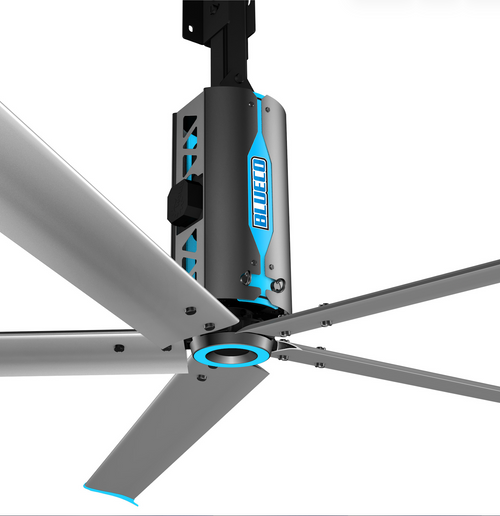
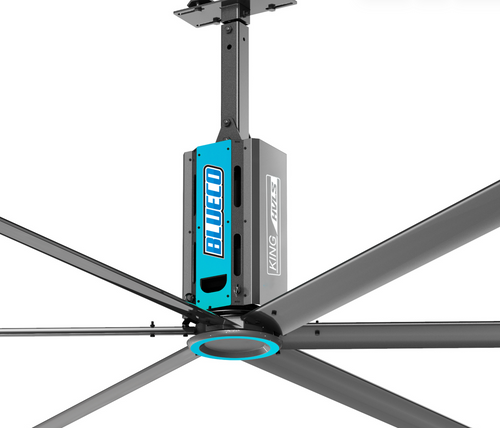
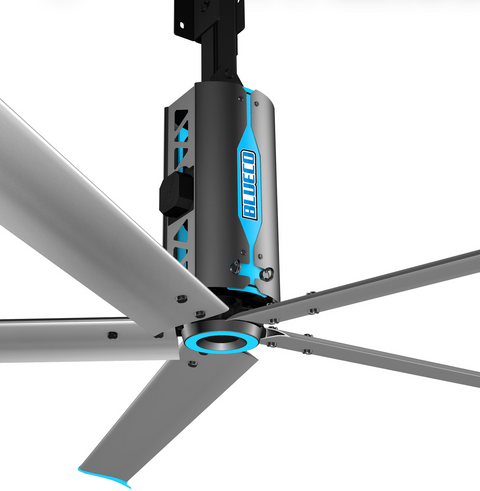
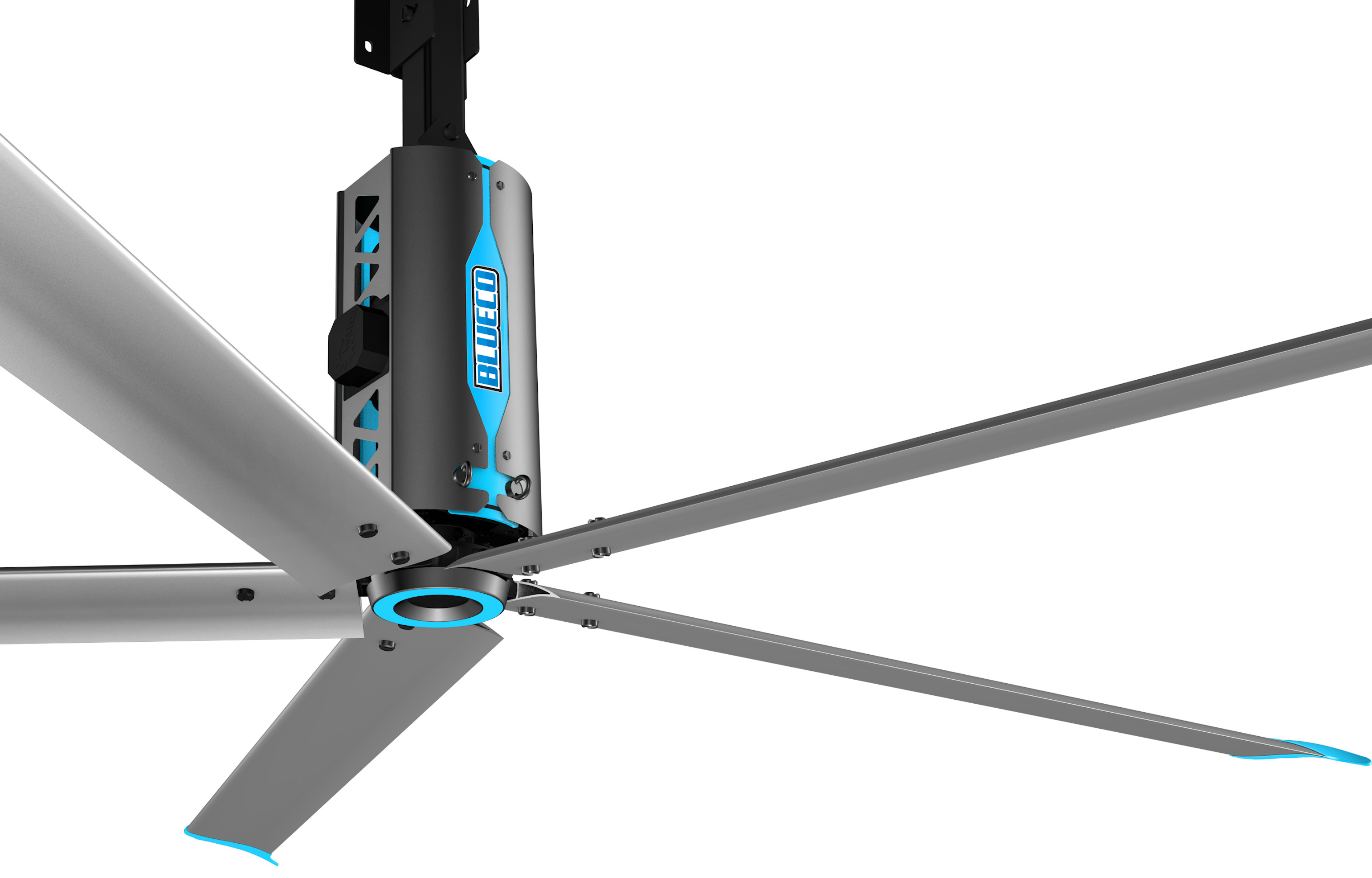
The most distinctive feature of HVLS fans is their enormous blade span, typically ranging from 6 feet to 24 feet in diameter. These aren't simply scaled-up versions of standard ceiling fans—HVLS blades feature sophisticated aerodynamic profiles, including tilt, taper, and twist variations along their length. This complex blade geometry, inspired by aerospace engineering and helicopter rotor design, enables the blades to move massive air volumes efficiently.
The large surface area of each blade (or set of blades—HVLS fans typically have 3-5 blades) displaces significantly more air with each rotation. Because the blades rotate slowly, they don't create the turbulent, disruptive wind patterns associated with high-speed fans. Instead, they generate a laminar flow—smooth, organized air movement that travels far and wide before dispersing.
Motor Technology
HVLS fans utilize direct-drive motors—gearless systems that connect the motor directly to the blade hub. This innovative motor design eliminates mechanical losses associated with gearbox systems, resulting in energy efficiency levels 30-50% better than conventional industrial fans. The direct-drive motor also reduces maintenance requirements, as there are fewer moving parts and lower mechanical stress on components.
The motor is typically mounted in a sturdy housing at the fan's center, protected from dust and environmental contaminants. Variable Frequency Drives (VFDs) often accompany HVLS fan systems, allowing facility managers to adjust fan speed according to specific comfort and energy efficiency needs. This flexibility enables operators to fine-tune performance throughout the year, scaling back fan speed during cooler months or increasing it during peak heat periods.
Hub Connection and Structural Integrity
The connection between motor and blades is critical to HVLS fan performance and safety. Industrial HVLS fans employ three-way motor-to-hub safety connections that secure the blades while accommodating the centrifugal forces generated during operation. This engineering approach, borrowed from helicopter rotor designs, ensures long-term reliability and eliminates vibration issues that plague lower-quality fan systems.
How HVLS Fans Work: The Physics of Air Circulation
Understanding how HVLS fans achieve their remarkable air-moving capabilities requires examining the fluid dynamics and mechanical principles underlying their operation.
The Coandă Effect and Airflow Pattern
When an HVLS fan operates, the rotating blades pull air downward from above and push it in a descending conical pattern toward the floor. This air movement follows the Coandă effect—a scientific principle describing how fluid flows along curved surfaces. As the downward-moving air contacts the floor, it doesn't dissipate chaotically but rather spreads outward horizontally in a controlled pattern called the "horizontal floor jet."
This horizontal floor jet spreads evenly in all directions from the fan's center, creating a gentle, consistent breeze that can be felt throughout the entire facility. Unlike turbulent air from traditional fans that rises quickly and dissipates, the floor jet from HVLS fans maintains its character across much larger distances, effectively distributing air across areas of 20,000 square feet or more with a single fan.
Air Stratification and Temperature Mixing
In large, enclosed spaces like warehouses and manufacturing facilities, air naturally stratifies—warmer air rises toward the ceiling while cooler, denser air settles near the floor. This thermal stratification creates significant temperature variations between ceiling and floor level, sometimes differing by 10-20°F. This variation complicates climate control and forces HVAC systems to work harder to maintain comfortable conditions.
HVLS fans disrupt this natural stratification through continuous, gentle air circulation. By continuously moving air downward and outward, they break up the moisture-saturated boundary layers surrounding workers and equipment, accelerating evaporation and creating a subjective cooling effect of up to 15°F. More importantly, the continuous mixing action equalizes temperatures throughout the facility, reducing the thermal differential and allowing centralized HVAC systems to operate far more efficiently.
Laminar vs. Turbulent Flow
The slow rotation speed of HVLS fans creates laminar airflow—smooth, organized air movement without eddies, swirls, or turbulence. Laminar flow travels farther and maintains its character over greater distances than turbulent flow. High-speed traditional fans create turbulent airflow that degrades quickly, loses energy rapidly, and often creates uncomfortable drafts.
By maintaining laminar flow patterns, HVLS fans achieve superior coverage, consistency, and energy efficiency. Occupants experience gentle, pleasant air movement rather than disruptive breezes. Additionally, laminar flow preserves air momentum, allowing a single HVLS fan to effectively condition spaces that would require multiple traditional fans.
Industrial HVLS Fans vs. Traditional Industrial Fans: Understanding the Differences
While both HVLS and traditional industrial fans serve industrial and commercial applications, they differ significantly in design, performance characteristics, and operational efficiency.
Power and Coverage Area
Traditional industrial fans typically feature smaller blade spans (3-6 feet) and operate at higher speeds (200+ RPM) to generate concentrated airflow in limited areas. They excel in applications requiring focused ventilation in specific zones. However, their coverage area remains relatively limited, often requiring multiple units to condition large spaces effectively.
HVLS fans, conversely, feature massive blade spans (6-24 feet) operating at low speeds (20-60 RPM), enabling single units to effectively condition areas of 20,000+ square feet. A single HVLS fan can replace three to five traditional industrial fans, reducing installation costs, electrical requirements, and maintenance burden while improving air quality and consistency.
Durability and Operating Environment
Industrial fans are engineered for harsh environments, featuring robust construction with heavy-gauge materials, welded frames, and sealed motors capable of withstanding dust, heat, chemicals, and extreme temperatures. They're designed for continuous 24/7 operation in demanding manufacturing environments.
HVLS fans combine industrial durability with refined engineering, featuring aerospace-grade blade profiles and advanced motor technology. Many industrial-grade HVLS systems operate maintenance-free for 50,000+ hours—equivalent to six years of continuous operation. Both fan types are built tough, but HVLS systems achieve superior reliability through advanced design rather than simply heavier materials.
Noise Levels
Traditional high-speed industrial fans often generate significant noise—often exceeding 85 decibels, which approaches levels that require hearing protection. This noise affects worker comfort, productivity, and safety.
HVLS fans operate virtually silently, typically generating only 65-75 decibels due to their slow blade rotation and optimized aerodynamic design. This quietness dramatically improves the workplace environment while eliminating hearing protection requirements and associated complications.
Energy Efficiency
Traditional fans consume substantial energy, particularly when multiple units operate simultaneously to cover large areas. A typical industrial fan consuming 2-5 kilowatts, with facilities requiring five or more units, can demand 10-25+ kilowatts continuously.
HVLS fans, through advanced motor technology and aerodynamic efficiency, consume far less energy—typically 0.5-2.5 kilowatts for units covering 20,000+ square feet. Combined with HVAC system load reductions, facility operators achieve energy savings of 20-50%, translating to substantial utility cost reductions and improved sustainability metrics.
Installation and Maintenance
Traditional industrial fans often require simple mounting to walls, posts, or ceiling joists, with straightforward electrical connections. However, multiple units require multiple installation points, creating complexity in large facilities.
HVLS fans require careful installation on structurally sound ceiling beams or I-beams capable of supporting 200-350+ pound fan weights. However, because a single HVLS fan replaces multiple traditional fans, overall installation complexity often decreases despite individual unit requirements. Maintenance needs similarly decrease due to superior reliability and fewer installed units.
The Performance Benefits of HVLS Fans in Commercial and Industrial Settings
Beyond air circulation, HVLS fans deliver measurable benefits that directly impact operational efficiency, worker safety, and financial performance.
Energy Efficiency and Cost Reduction
The most compelling benefit of HVLS fans is their remarkable energy efficiency. According to the U.S. Department of Energy, properly installed industrial fans can reduce cooling costs by up to 30%, with some facilities achieving reductions of 50% by optimizing air circulation. The American Society of Heating, Refrigerating and Air-Conditioning Engineers (ASHRAE) reports that improved air movement can reduce HVAC system workload by up to 50%, directly translating to lower energy costs.
When facility managers implement HVLS fan systems, they typically achieve payback periods of 6-18 months through energy savings alone. After the initial investment is recouped, continuous utility savings compound, often exceeding initial cost projections over the fan's operational life. For facilities with high cooling demands or expensive electricity rates, HVLS fan investments deliver exceptional returns.
Improved Worker Comfort and Productivity
Research consistently demonstrates that thermal comfort directly affects worker productivity. When facility temperatures exceed comfortable ranges due to poor air circulation, productivity declines measurably. HVLS fans address this challenge by maintaining uniform temperatures and providing gentle air movement that creates a subjective cooling effect.
Workers in well-ventilated spaces report greater comfort, experience fewer heat-related health issues, and maintain higher productivity levels. For facilities employing large workforces, these improvements compound across hundreds of employees, delivering productivity gains that far exceed the HVLS fan investment.
Equipment Protection and Extended Lifespan
Many industrial processes generate heat that requires constant cooling to protect sensitive equipment. Without proper air circulation, heat accumulates in specific areas, compromising equipment performance and reducing lifespan. HVLS fans distribute air evenly, preventing localized hot spots and maintaining consistent temperatures that protect valuable manufacturing and storage equipment.
This protection extends equipment lifespan, reduces maintenance frequency, and minimizes unexpected downtime from heat-related failures. For facilities operating expensive machinery, these benefits justify HVLS fan investment independently of energy savings.
Air Quality Improvement
Stagnant air in large facilities accumulates dust, moisture, and airborne pollutants. HVLS fans combat this through continuous gentle circulation that prevents air stagnation. This improved air movement reduces mold growth risk in moisture-prone environments, minimizes dust accumulation on surfaces and equipment, and improves overall air quality for workers.
The humidity control benefits alone make HVLS fans valuable in warehouses storing sensitive materials, food processing facilities, or any environment where moisture control is critical. By maintaining air movement, HVLS fans reduce the likelihood of product damage from moisture and mold.
Installation Requirements and Structural Considerations
Before implementing HVLS fan systems, facility managers must address several critical installation requirements and structural considerations.
Overhead Clearance and Space Assessment
HVLS fans require substantial overhead clearance for safe operation and optimal airflow performance. Minimum clearances typically include at least 10 feet from the lowest fan blade to the floor, 3+ feet from sprinkler deflectors (per NFPA 13 fire code), and additional clearance from any ceiling-mounted obstructions like HVAC ductwork, lighting, or structural elements.
Facility managers must conduct thorough space assessments before installation, mapping ceiling heights, identifying obstructions, locating load-bearing beams, and planning installation locations that maximize air circulation coverage. Industrial engineers often create detailed installation plans showing fan placement, clearance dimensions, and electrical routing.
Structural Load Support
HVLS fans are substantial pieces of equipment, ranging from 200 to 350+ pounds depending on blade diameter and motor specifications. The supporting structure—ceiling beam, I-beam, or specially designed framework—must be engineered to safely support this load, including dynamic stresses generated during operation.
Facility managers must verify structural capacity before installation. In older facilities with wooden ceiling joists or deteriorated steel structures, structural reinforcement may be necessary. Professional structural engineers can assess existing support capacity and recommend reinforcement if required.
Electrical Requirements
Most industrial HVLS fans operate on 208-480V three-phase electrical systems, far exceeding standard single-phase residential electrical configurations. Facilities must provide dedicated circuits, proper voltage supply, and professional electrical installation to ensure safe, reliable operation.
Variable Frequency Drives (VFDs) that accompany many HVLS systems require sophisticated electrical controls and often professional programming to achieve optimal energy efficiency and performance tuning. Facilities should budget for professional electrical contractors experienced in industrial fan installation.
Fire Safety Integration
Fire codes, particularly NFPA 13 (sprinkler system standards), impose specific requirements on HVLS fan installation. Maximum fan diameter is limited to 24 feet, and fans must be positioned at least 3 feet below sprinkler deflectors. Additionally, fans typically include automatic shutdown mechanisms that activate when fire alarm systems trigger, ensuring fans don't interfere with sprinkler system operation during emergencies.
Understanding HVLS Fan Pricing and ROI Analysis
HVLS fan investment varies based on multiple factors including blade diameter, motor specifications, installation complexity, and regional labor rates.
Cost Components
HVLS fan systems typically range from $5,000 to $30,000+ for equipment alone, depending on specifications and brand reputation. A 20-foot diameter commercial HVLS fan with variable speed controls and installation hardware might cost $15,000-$25,000. Installation labor, structural modifications, and electrical work can add 20-40% to equipment costs.
For facilities requiring multiple units or complex installation scenarios, total investments might reach $100,000+. However, when compared to alternative climate control solutions or the cost of replacing traditional fan systems, HVLS fan investments often prove cost-competitive while delivering superior long-term value.
ROI Calculation
The primary ROI driver for HVLS fans is energy savings. A facility reducing energy costs by $300-$500 monthly (typical for medium-sized installations achieving 30% HVAC system load reduction) achieves annual savings of $3,600-$6,000. With an installed cost of $20,000, the simple payback period is 3-5.5 years, well within typical equipment life expectations of 15-20+ years.
However, when including secondary benefits—improved worker productivity, reduced equipment maintenance costs, improved air quality benefits, and sustainability metrics—actual ROI often exceeds financial models. Many organizations report that HVLS fan investments deliver positive returns within the first 2-3 years when all benefits are considered.
Frequently Asked Questions About HVLS Fans
Q: What's the difference between HVLS fans and regular ceiling fans?
A: Regular ceiling fans feature small blades spinning at high speeds (200+ RPM), creating concentrated airflow in limited areas. HVLS fans feature massive blades (6-24 feet) rotating slowly (20-60 RPM), moving tremendous air volumes across expansive spaces with remarkable energy efficiency and minimal noise.
Q: How many square feet can a single HVLS fan cover?
A: A typical industrial HVLS fan effectively conditions 15,000-20,000+ square feet, depending on blade diameter, ceiling height, and obstructions. A 20-foot diameter HVLS fan can cover areas exceeding 20,000 square feet with consistent, gentle air movement.
Q: Can HVLS fans operate year-round?
A: Absolutely. Most HVLS fans feature reverse operation, allowing them to push warm air downward during winter months while maintaining air circulation year-round. This flexibility maximizes energy efficiency benefits throughout all seasons.
Q: What maintenance do HVLS fans require?
A: Industrial HVLS fans require minimal maintenance—typically just periodic visual inspections and occasional blade cleaning to remove dust accumulation. Many modern systems operate maintenance-free for 50,000+ hours of continuous operation, far exceeding traditional fan requirements.
Q: Are HVLS fans safe for facilities with sprinkler systems?
A: Yes. HVLS fans are specifically engineered for sprinkler system compatibility, with fire code integration including automatic shutdown mechanisms and specific clearance requirements (typically 3+ feet below sprinkler deflectors) that ensure safe operation without interference.
Q: Do HVLS fans work in facilities with very high ceilings?
A: HVLS fans excel in high-ceiling facilities—actually, higher ceilings are often preferable, as they provide space for larger fans and clearer airflow patterns. Facilities with ceilings exceeding 25 feet particularly benefit from HVLS fan installations.
Q: How do HVLS fans reduce energy costs?
A: HVLS fans reduce HVAC system load by up to 50% through efficient air distribution, eliminating temperature stratification, and maintaining consistent comfort with lower cooling requirements. This translates directly to reduced utility consumption and lower electricity bills.
Q: Can I install an HVLS fan in an existing facility?
A: Yes, most facilities can accommodate HVLS fan installation, though structural assessment may be necessary. Professional installation teams evaluate ceiling construction, overhead clearance, structural capacity, and electrical infrastructure to determine installation feasibility.
Q: What size HVLS fan should I choose for my facility?
A: Fan size depends on facility dimensions, ceiling height, obstructions, and specific application requirements. Facilities with 20,000 square feet or less typically require single 16-20 foot diameter fans, while larger facilities may need multiple units or larger diameter fans. Consult with industrial ventilation specialists to determine optimal sizing.
Q: Are HVLS fans quiet?
A: Yes, HVLS fans operate virtually silently due to their slow blade rotation and optimized aerodynamic design, typically generating only 65-75 decibels compared to 85+ decibels for traditional industrial fans.
Transform Your Facility's Climate Control with HVLS Fan Technology
HVLS fans represent a fundamental shift in how modern facilities approach ventilation and climate control. By moving massive air volumes at low speeds, these scientifically engineered systems deliver energy efficiency, worker comfort, and operational benefits that traditional ventilation solutions cannot match.
Whether you operate a sprawling warehouse, a manufacturing facility, a commercial building, or any large industrial space, HVLS fans from BlueCo Brand can transform your climate control strategy. The combination of remarkable energy savings, improved worker conditions, equipment protection, and long-term reliability makes HVLS fan investment one of the smartest decisions facility managers can make.
Ready to explore how HVLS fans can improve your facility's performance and reduce operational costs? Visit our extensive HVLS fan collection to discover options tailored to your specific needs, or contact our industrial ventilation specialists today for a personalized assessment. At BlueCo Brand, we're committed to providing high-quality industrial fans engineered for excellence, delivered with professional installation support, and backed by outstanding customer service.
Transform your facility's climate control today—your energy bills and your workers will thank you.
BlueCo Brand - Industrial HVLS Fan Solutions
- Address: 2615 N Arygle , Fresno CA
- Phone: 1-866-865-1902
- Email: Support@bluecobrand.com
For expert guidance on selecting the perfect HVLS fan system for your facility, visit our homepage or browse our complete collection of commercial and industrial fans today.
Share:
The Benefits of a Middle Drive Walkie Straddle Leg Pallet Stacker
Evaporative Coolers for Workshops, Garages & Patio Spaces